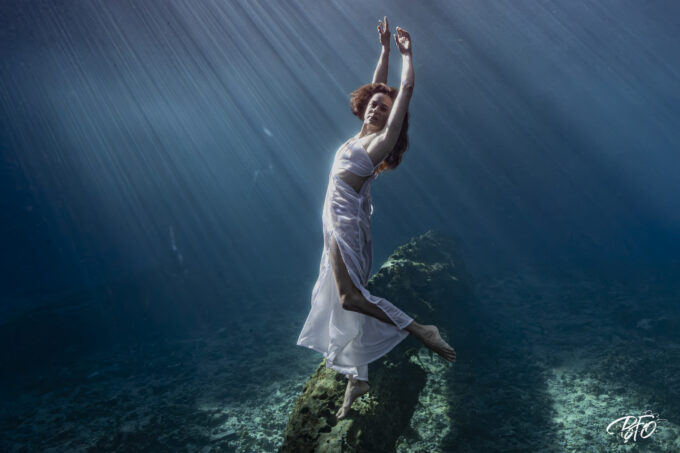

Are your underwater photos blue, blurry and full of little white specks? Don’t worry: it’s not your camera. Water absorbs colour, scatters light and bounces your flash off every particle. All of this can be fixed, as long as you know how. That’s exactly what I teach you, on real dives, in New Caledonia’s lagoon: one of the largest reef systems in the world, a UNESCO World Heritage Site since 2008.
At a glance
- 3 options: a one-day discovery trip at sea, a complete 4-day course, and an underwater editing workshop.
- One-to-one, on weekdays, dives, boat trip and meals included.
- Safety first: never deeper than 10 m, 50 minutes maximum per dive.
- For independent divers (PA20: French FFESSM Level 2, PADI Advanced Open Water or equivalent) with at least 50 logged dives.
- From 70,000 XPF to 190,000 XPF (about €585 to €1,590), online booking at least 10 days in advance.
Why learn here, and not anywhere else
New Caledonia is a rare place to learn. The lagoon is home to around 20,000 documented marine species, including 401 species of coral and more than 2,300 species of fish (IUCN, 2025). In the cool season, from April to September, visibility regularly reaches 30 to 40 metres and the water sits around 22–23 °C; in the warm season, it climbs to 27–28 °C. Best of all, we shoot in 5 to 10 metres of water: where sunlight is still generous, where you can stay down for a long time and focus on the image rather than on depth.
The 5 mistakes we fix from the very first dive
- Red disappearing within the first few metres: you learn to set colours manually and bring them back in editing.
- Distance: every metre of water dulls the image. You learn to get close, much closer than you think.
- “Snow”: particles lit up by your flash. It’s all about strobe placement.
- Instability: we work on staying still and balanced with the camera in hand, without touching the reef.
- Approaching marine life: getting close without disturbing is the key to shots of fish looking straight at you.
Option 1 · First Images Underwater (1 day, 80,000 XPF / about €670)
Who it’s for: divers who want to discover underwater photography with real-time guidance. Included: boat trip, 2 dives, lunch.
- 8 am – 10 am · Briefing. Preparing your housing with no risk of leaks or fogging, setting up your camera for the water, staying still and stable, approaching marine life without disturbing it.
- 10 am – 3 pm · At sea, 2 dives. Two guided dives, most often from a small lagoon island, in 5 m of water: ideal for finding your feet.
- 3 pm – 5 pm · Debrief and editing. We sort your photos and bring their colours back.
Option 2 · The Blue Course (4 days, 190,000 XPF / about €1,590)
Who it’s for: those who want to master light underwater, from preparation to editing. Included: 2 days at sea, 4 dives to 10 m, meals.
- Day 1 · In the studio. What water does to your photos: red disappearing, the image dulling with distance, “snow” from particles and how to position your strobes to avoid it. A stability exercise in shallow water.
- Day 2 · At sea, 2 dives to 10 m. Sunlight: sunrays, silhouettes, shooting up towards the surface into the light, colours set manually, and over-under (split) shots if the sea allows.
- Day 3 · At sea, 2 dives to 10 m. Flash light: small subjects up close, fish portraits, blue or black backgrounds. We fix the previous day’s mistakes.
- Day 4 · In the studio. Editing specific to underwater images: true colours, green or blue cast, “snow”, contrast and sharpness, exporting for screen and print.

Option 3 · “Colours Restored” Workshop (1 day in the studio, 70,000 XPF / about €585)
A full day of advanced editing, 100% dedicated to underwater photography, with no diving. Prerequisites: photography Level 3 (“Portraits and Editing Like a Pro”) or equivalent, and a working knowledge of Lightroom. Bring your files, ideally in RAW.
- Workflow and presets: creating your own underwater presets, applying them to a series then fine-tuning photo by photo, using a graphics tablet.
- Colour underwater: white balance by depth, colour grading with layers, bringing back reds without spoiling the blue.
- Cleaning up the image: snow, particles, flash reflections, bubbles, haze.
- Depth and light: luminosity masks, local contrast, selective sharpening, noise in low light.
- Finishing touches: over-under shots, underwater black and white, exporting for screen and print, editing your own images.
Which option should you choose?
| You want to… | The option | Price |
|---|---|---|
| Try underwater photography, with expert support | First Images Underwater · 1 day | 80,000 XPF (about €670) |
| Go home with a complete method and images you’re proud of | The Blue Course · 4 days | 190,000 XPF (about €1,590) |
| Make the most of photos you already have | Colours Restored · 1 day | 70,000 XPF (about €585) |
50% deposit on confirmation. Optional transport from your home: 10,000 XPF / about €85 (1 day) or 25,000 XPF / about €210 (4 days). Want a program built around you? The underwater course can also be tailored on quote.
The prerequisites, clearly
- Diving level: independent diver to 20 m (PA20): French FFESSM Level 2, PADI Advanced Open Water or equivalent.
- Experience: at least 50 dives, to be proven on the day (logbook or dive computer history), along with your certification card.
- Photography level: for the discovery day and the Blue Course, you need to have completed on-land Level 2, “Take Full Control” or equivalent (booking page in French — you can also write to me in English).
- Health: an up-to-date medical certificate, plus the diver’s medical questionnaire and a waiver signed online before the contract. If any answer requires it, a doctor’s clearance must be provided before the course.
- Equipment: fins, mask and wetsuit; a BCD is recommended. A camera in an underwater housing is preferable but not compulsory: we’ll talk about it before the course.
To choose your housing, read my guide to underwater photography equipment.
Safety, no compromises
Dives go from 5 m off a small island down to 10 m in the lagoon, never deeper, and 50 minutes maximum. All trips depend on the weather: in strong wind or rough seas, we reschedule. This deliberately cautious framework leaves your mind free for the only thing that matters: the image.
Booking
- Choose your option and a weekday date on the Courses page, at least 10 days in advance (to allow time to approve the medical questionnaire).
- I confirm within 24 hours; you fill in the questionnaire, sign the contract and pay the deposit by card via PayPal.
- We dive.
Frequently asked questions
I don’t have a housing. Is that a problem?
No. A housing is preferable, but we’ll discuss it together before the course to find the best solution.
What’s the best season?
April to September for water clarity (often 30 to 40 m of visibility), with a thicker wetsuit; October to March for warmer water.
Why not dive deeper?
Because light, colour and bottom time are all better near the surface, and it’s safer. The lagoon’s most beautiful images are often taken in less than 10 m.
I’m a tourist. Can I book?
Yes, as long as you meet the diving prerequisites. Remember to book at least 10 days before your course.
New Caledonia’s lagoon is one of the best-kept secrets in the Pacific. Learn to photograph it the way it deserves. Choose your underwater course and book → · For inspiration: the underwater portfolio.